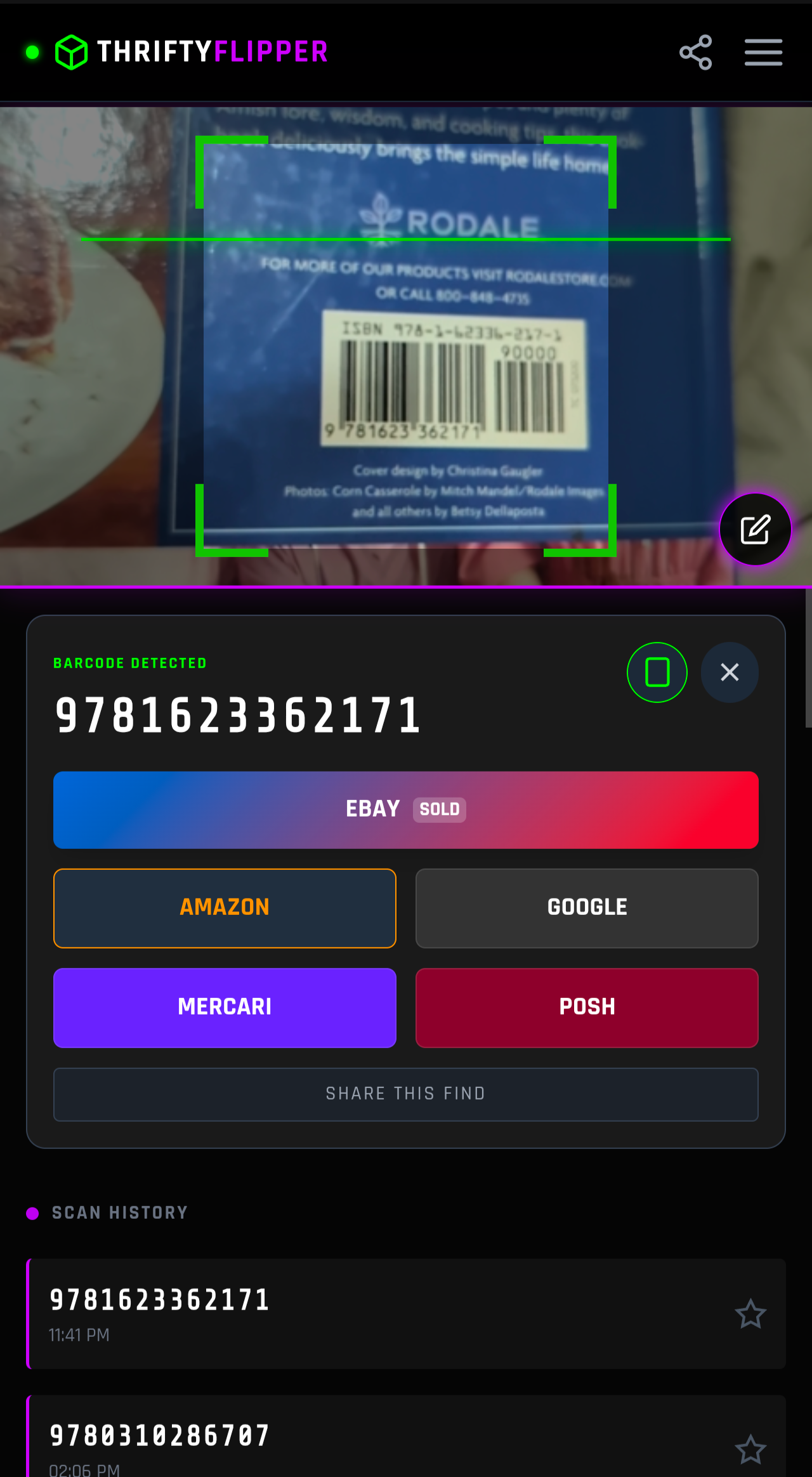
Manual barcode entry: type the digits when the label will not scan
You are holding a package in an aisle with the camera on it, and the bars will not read: glare off shrink wrap, a scraped label, a price sticker sitting right on the code. Every retail barcode on that package has its number printed beside it in plain digits, and that line of text is the fallback that always works. A manual barcode entry app exists for exactly this moment. You read the digits, you type them, and you get the same product lookup a scan would have given you, without the ten seconds you would have spent re-aiming.
What is printed on the label, and how long each number is
You will meet six formats in a store. The fastest habit to build is counting the digits before you type anything, because the count tells you what you are holding and whether the number is worth entering at all.
| Format | Digits printed | Where you see it | Type it in? |
|---|---|---|---|
| UPC-A | 12 | Standard US and Canada retail packages | Yes, all 12 |
| EAN-13 | 13 | Goods packaged outside North America | Yes, all 13 |
| UPC-E | 8 | Small packages: gum, cosmetics, single-serve cups | Yes, all 8 |
| EAN-8 | 8 | Very small items coded outside North America | Yes, all 8 |
| ISBN-13 | 13 | Books, starts with 978 or 979 | Yes, all 13 |
| ITF-14 | 14 | Shipping cases and multipacks, heavy border | No, not for the unit in your hand |
Three relationships in that table cover most of the confusion. A UPC-A is an EAN-13 with a leading zero: the same product number written with a 13th digit in front, and the bars do not change. UPC-E is not a different product number either, it is a full 12-digit code compressed to fit a small package by removing zeros, and references that describe the UPC-E symbol as six digits are counting what the bars carry rather than what is printed. Six sit in the bars, eight are printed, and you type all eight. ISBN-13 uses the same EAN-13 symbol as everything else, with 978 and 979 reserved for books, so a book is a normal code with a book prefix.
One more piece of the label, before you type. Books and some groceries carry a short second block of digits beside the main code. That five-digit add-on is a price or promotion marker, not part of the product identity, so it does not go in the field.
Which digits sit outside the bars
The printed digits are not arranged casually, and this is where the most expensive typing error starts. On a UPC-A the number system digit on the left and the check digit on the right are printed outside the guard bars, so a person reading only the digits between the bars sees ten digits instead of twelve and decides the code is incomplete. It is not incomplete. On an EAN-13 the leading digit is printed in the left margin because that digit is not drawn as bars at all, and the check digit stays inside the symbol, which is why EAN-13 reads continuously and UPC-A does not. On books the human readable line prints above the symbol and starts with the letters ISBN.
Practical consequence: when something partially covers the code, the digits at the outer edge, the ones outside the bars, are often the survivors. Read the whole line, margins included.
The last digit is a check digit
In every format in that table the final digit is computed from the digits ahead of it using the GS1 modulo 10 method: alternating weights of 3 and 1, sum the products, and the check digit brings the total to the next multiple of ten. It catches a single mistyped digit and most transpositions. Two things follow. Type the check digit like any other digit, and never repair a number that fails a lookup by changing the last digit. When a 12-digit string resolves to nothing, the likelier cause is a digit mistyped in the middle, or a number that was never a GTIN in the first place.
Stickers that replace the real code
Price gun labels are the most common reason a typed number goes nowhere. A store's own label carries the store's price or its internal item number, which identifies the item in that retailer's system and nowhere else, and on clearance or repackaged goods it can sit directly on top of the manufacturer code. Thrift chains and liquidators do the same thing with their own barcode series. If the digits you are reading came from a sticker with a store logo on it, stop: you are about to type an inventory number, not a product code.
What to do, in order:
- Peel the sticker back at one corner. If the original bars survived underneath, scan or type those.
- Find a second barcode on the package. Manufacturers often print the same code on the bottom panel or a side seam.
- If the item is store-brand or repackaged with only the store label, the code is internal. Match the item by brand and description instead of by number.
- Handwriting over the bars, library tape, a security tag and packing tape across the symbol all produce the same dead end. Stop typing and switch to identifying the item by appearance.
When there is no barcode at all
Handmade goods, vintage items, craft items, garage sale finds and anything that has left its original packaging have no digit string to type. There is no number to look up, so no entry field on any app can help. That is the moment to switch to a picture search, let the tool identify the item from how it looks, and price it from comps. Typing is a fallback for a code that exists and will not read. It is not a substitute for a code that was never printed.
Why typing is often faster than fighting glare
A camera scan is a physical negotiation. Shrink wrap reflects the light source straight back into the lens, curved bottles never present the whole symbol flat at once, clamshell packaging puts a second layer of plastic over the code, and fine wrinkles in a poly bag break the bar widths. Some conditions never resolve with more aiming:
- Glare sitting on the bars rather than beside them, off shrink wrap, a clamshell or a laminated cover
- Curved surfaces on bottles and cans
- Low contrast labels, matte ink on a dark background, or print faded to grey
- Thermal labels that have gone nearly blank after a season on a shelf
If the camera has gone ten seconds without a lock, look down at the digits. Reading twelve characters and typing them is a fixed mechanical action with no light dependency and no angle, and it works whenever the digits are printed at all. Scanning stays the default; typing is the fallback, and knowing which moment calls for which is what saves time in the aisle. The camera side of this, including which apps handle which failure, belongs on the barcode scanning apps for resellers page.
How to type a code so it resolves
- Count first. Match the digit count to the table above so you know you read the whole label, margins included.
- Digits only. No dashes, no spaces, no letters. A code printed as 0 12345 67890 5 goes in as 012345678905.
- Keep every leading zero. A 12-digit UPC-A that starts with 0 still starts with 0, and dropping it produces a different number that matches nothing.
- Keep the final check digit. It is part of the number, not decoration.
- Do not pad a short code. If you counted eight digits, type eight. Adding zeros to a UPC-E to reach twelve changes the number.
- Skip the add-on digits. Two-digit and five-digit supplements carry price and promotion data, not product identity.
- Skip 14-digit case codes for single items. An ITF-14 identifies the case or multipack; the unit inside carries its own 12- or 13-digit code, and that is the one you need if you are reselling the unit.
What a typed code returns on Amazon
Amazon resolves a typed 12- or 13-digit code against its own catalog, and every catalog product carries an ASIN, the 10-character alphanumeric identifier Amazon assigns. The match is made for you: you type the number from the package and Amazon returns one product page, which gives you sales rank, current price, offer count and any selling restrictions that apply to your account. A typed code that returns nothing from Amazon is a real answer rather than a dead end. No catalog entry usually means no FBA arbitrage play on that item, though it says nothing about whether the same item sells on eBay.
What a typed code returns on eBay
eBay works differently, and expecting a clean catalog match is the mistake. eBay can match a GTIN to a catalog product page that groups listings, but coverage is not complete, and eBay's own developer documentation tells sellers that a UPC goes in as a UPC lookup while other GTIN formats have to be searched as keywords. In practice a typed code on eBay behaves like a search string, so the returned listings are candidates and you are the sanity check. Three checks per result, every time:
- The title matches the exact item, including size, model number and color. A near miss is a different product with a different value.
- The condition is comparable to what is in your hand. A results page mixes new stock, used units, parts-only listings, manuals and empty boxes.
- The price is the right kind of price. An active asking price and a sold price are different numbers, and one sold listing beats ten asking prices that never converted.
A seller moving a lot of six inflates nothing useful, so divide or skip. Once you have the correct match, the digits are only half the job.
Type it, check it, price it
Type the digits, confirm the match is the item in your hand, then run the margin before anything goes in your basket. Cost, fees and shipping are what turn a green screen red, so put the numbers through the arbitrage calculator first. If a typed code resolves to the wrong product, stop and re-read the digits. Either a digit is wrong or the number belonged to a sticker, and both are faster to fix than a bad buy.
The link matrix owns this page's exit block; the targets are listed in the internal links table below and are not repeated in body copy.
Next steps
Keep going from here: barcode scanner for resellers upc vs ean for resellers arbitrage calculator.