Flea Market Scanner App
Counted by script: 1,992 words of body copy including table cells and FAQ answers, inside the 1,300 to 2,000 band.
A flea market is the only US sourcing venue where the sticker price is an opening offer, most of the stock carries no barcode at all, and the same tool can cost $5 at one booth and $25 at the next. The National Flea Market Association counts over 1,100 US flea markets, about 2.25 million vendors and more than $30 billion in annual sales. A flea market scanner app earns its keep here, but only if you point it at the right things and handle the rest with your hands. This page is the method, not the features.
What makes a flea market different from every other source
| Flea market | Big box or chain | |
|---|---|---|
| Who sets the price | One person, per item, per booth | A price file |
| Price for the same item | Different at every table | Identical in every store |
| Who you deal with | The owner of the table, alone. No manager, no price match | A cashier following policy |
| Payment | Mostly cash, some card | Card, tap, receipt |
| Return counter | None | Thirty days |
| Barcode on the goods | On packaged stock only | On nearly everything |
| Best hour | The first hour after the gate | Whenever |
A store is a matching problem: find the label, scan it, compare the numbers. A flea market is a research problem with a clock on it, because the inventory is one of each and the person holding it will take an offer.
Some of those sellers are licensed businesses with a sales tax obligation and some are clearing a garage. Ohio's tax department makes the split plain: a vendor who sells often at a flea market needs a $25 vendor's or transient vendor's licence, while someone selling personal property they already owned does not. Different paperwork means different pricing logic, which is why the same cast iron skillet sits twenty dollars apart in one row.
Get there at the gate, not at eleven
Market hours are weekend mornings almost everywhere. These are five real examples, each taken from the market's own page.
| Market | Public hours | Vendor side |
|---|---|---|
| Folsom Boulevard, CA | Sat and Sun, 7am to 5pm | Gates open at 6am |
| Patterson, NY | Opens 8am | Gate opens by 6:30am. Power on site for testing |
| Mile High, CO | Fri to Sun, 7am to 5pm | $20 to $44 a day per outdoor space |
| Londonderry, NH | 8am to 3pm | Nothing moves before the 8am bell |
| Visitors, FL | Opens 8am daily | Its own guide says the pros arrive at opening |
- The setup hour is your advantage. Stock is still in boxes, and vendors want an early sale to cover the space fee they already paid.
- Be inside for the first hour. The best single item in a market of one-of-a-kind goods is gone when it is gone.
- If you cannot go early, go late. Vendors cutting prices at 2pm beat vendors who will not move at 8am. It buys different inventory, not worse inventory.
- Leave by early afternoon. Vendors pack when sales slow, and the late crowd gets what is left of the boxes.
Walk the whole market before you buy anything
One fast loop with zero purchases is the highest-return habit at a market. You are mapping which booths carry your categories, where duplicate items sit, and how wide the price spread runs. The $5 skillet in row two does you no good if you already paid $25 in row one. Ten minutes of walking stops the most expensive mistake at a flea market: buying the first acceptable thing you see.
When the barcode exists, scan it
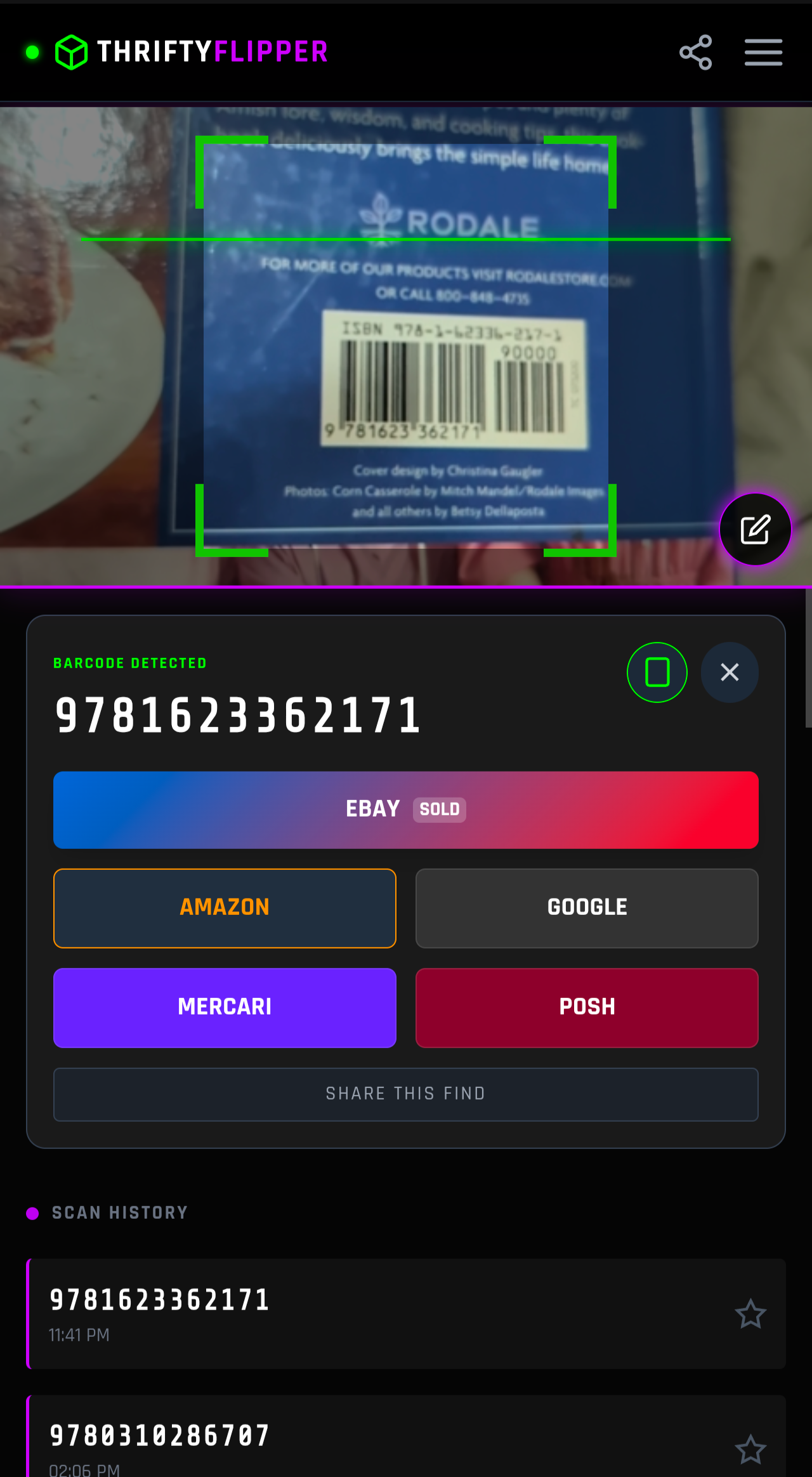
Packaged overstock, new-in-box closeouts and shelf-pull lots usually carry a real UPC. Scan those the normal way: point the camera, read the digits, check the sold price before the asking price. The full workflow from beep to buy-or-pass decision is on the barcode scanning apps for resellers page.
One caution. Repackaged and hand-labeled goods often carry a vendor's own sticker rather than a manufacturer code. If the code under the sticker scans to a product other than the one in your hand, trust your hands. That is a hand-labeled lot, and the digits are decoration.
When there is no barcode, use the fallbacks
At a good market this is most of the merchandise. There is no scan for a 1960s hand plane, a Pyrex bowl or a bin of sewing patterns. Three moves cover what the camera cannot read:
- Type the model number. Loose tools, unboxed toys, vintage electronics and appliances carry a stamped or printed model number instead of a label. Slower than a scan, and the difference between a guess and a number.
- Photograph the item. Loose clothing, glassware, pottery, signed pieces. A photo match by brand and form is your only digital path and still beats haggling blind.
- Set your number before the vendor names one. Look it up in the aisle or at the truck if the market has signal. Doing it after the vendor speaks anchors you in the wrong place.
An item with no code, no model number and no brand is a $2 gamble, not an investment.
Cash, change and what you actually brought
Most flea market vendors take cash only. Blue Ridge Flea Market's own FAQ states it plainly: cash is the preferred method, the majority of vendors will only accept cash, and shoppers should bring small bills because the ATMs on site charge for withdrawals. That fee matters when your margin on a $6 item is $3.
- Bring fives and tens. Change for a large bill is a negotiation tax. Handing over a hundred to a vendor with no change loses the deal and the goodwill.
- Treat the cash roll as the budget. Cleanest spending limit you will ever have, because there is no cart and no checkout screen.
- Keep a log as you go. Note the item and what you paid, on your phone, before you walk away. There is no receipt counter at a market, and your cost basis is what you need at tax time.
Talking price, one vendor at a time
Negotiation at a flea market is a two-person transaction. Keep it that way.
- Do the full loop first, then ask at three tables before you buy at any. Two minutes of walking routinely finds the same model at half the price.
- Bundle at the booth. Gather everything you actually want from one vendor and ask for one price on all of it. A vendor will move six items that will not move individually.
- Show the cash. "I have $30 cash for these three right now" closes deals a card does not.
- Never play vendors against each other by name. "The guy back there does better" burns both relationships. Ask each seller for their best price on its own merits.
- Know your ceiling before you open your mouth. If sold comps minus fees and shipping leave $14 of profit, $4 is your buy price and $6 is your walk-away.
Bulk lots: price the box, not the items
Flea markets are where household bulk goes to sell: a box of hand tools for $20, a flat of dishes for $15, a tote of cables for $10. These lots carry the real margins and ruin the most buyers.
- Ask the price for the whole box. Not per item.
- Count what is actually in it. Forty is rarely forty. Ten are broken, three are empty, two are someone's old phone chargers.
- Scan the ten best items and add realistic sold prices after fees. The other thirty are filler, and you are buying the filler to get the ten.
- Divide and offer. A $40 box holding $180 of realistic sold value in the top ten is a deal. A $40 box with $45 in the top ten is a weekend project with no paycheck.
Test electronics in front of the vendor, or pay less
A flea market sale is final. No return counter, no receipt, no vendor who wants to hear from you on Tuesday. Some markets make it easy: Patterson Flea Market advertises power on site so sellers can test, so bring your own cord, batteries and adapter. Then run this at the table.
- Ask to plug it in. A vendor who refuses a power test is telling you something. Price it as a parts item or leave it.
- Touch every control. Every button, knob, switch and slider. Intermittent switches are the most common silent defect in used audio gear and power tools.
- Open the battery door. Green or white crust on the contacts means corrosion, and corrosion spreads. A tool sold without its battery pack is half a tool.
- Test the one function that decides the value. A console plays a game. A camera saves a photo. A drill spins both ways.
- Confirm the model number matches the listing you priced. A near-identical model can sell for a third as much.
An untested $5 boombox is a fine gamble. The same boombox at $40 is not.
What to walk past
- Counterfeit or trademarked goods. Many markets prohibit them outright. Mile High Flea Market's seller rules ban counterfeit and trademarked merchandise, along with alcohol, tobacco and firearms. A fake is a defect in your business, not a cheap flip.
- Untestable high-value electronics. If the margin depends on the item working and nobody will let you prove it works, you are buying a lottery ticket with an eBay account attached.
- The table where the vendor knows more than you. Tool vendors who price by model number and record dealers who price by pressing are not leaving money on the table for you. Buy where the seller is clearing a household.
Where this fits, and the one rule that holds
Flea markets sit at the no-fixed-price end of physical sourcing. Driveway sales are the one-morning version, and the garage sale scanner app page covers their pricing logic. Thrift chains are the fixed-tag version, and the thrift store scanner app page covers store policy and tag math. For where a flea market sits next to the other sources, see best stores for retail arbitrage. When you are ready to scan, the free eBay arbitrage scanner runs in your phone browser with nothing to install. Whatever the venue, the rule holds: cash, one full loop before the first purchase, and no money out before the item works.
Next steps
Keep going from here: best stores for retail arbitrage garage sale scanner app thrift store scanner.