Garage Sale Scanner App
A garage sale is the one sourcing channel where the seller often has not priced a single item. There is a folding table, a driveway, and a person who wants that driveway back by noon. There is also a second problem. The seller is standing right there, watching you pull your phone out. A garage sale scanner app has to answer both in about ten seconds.
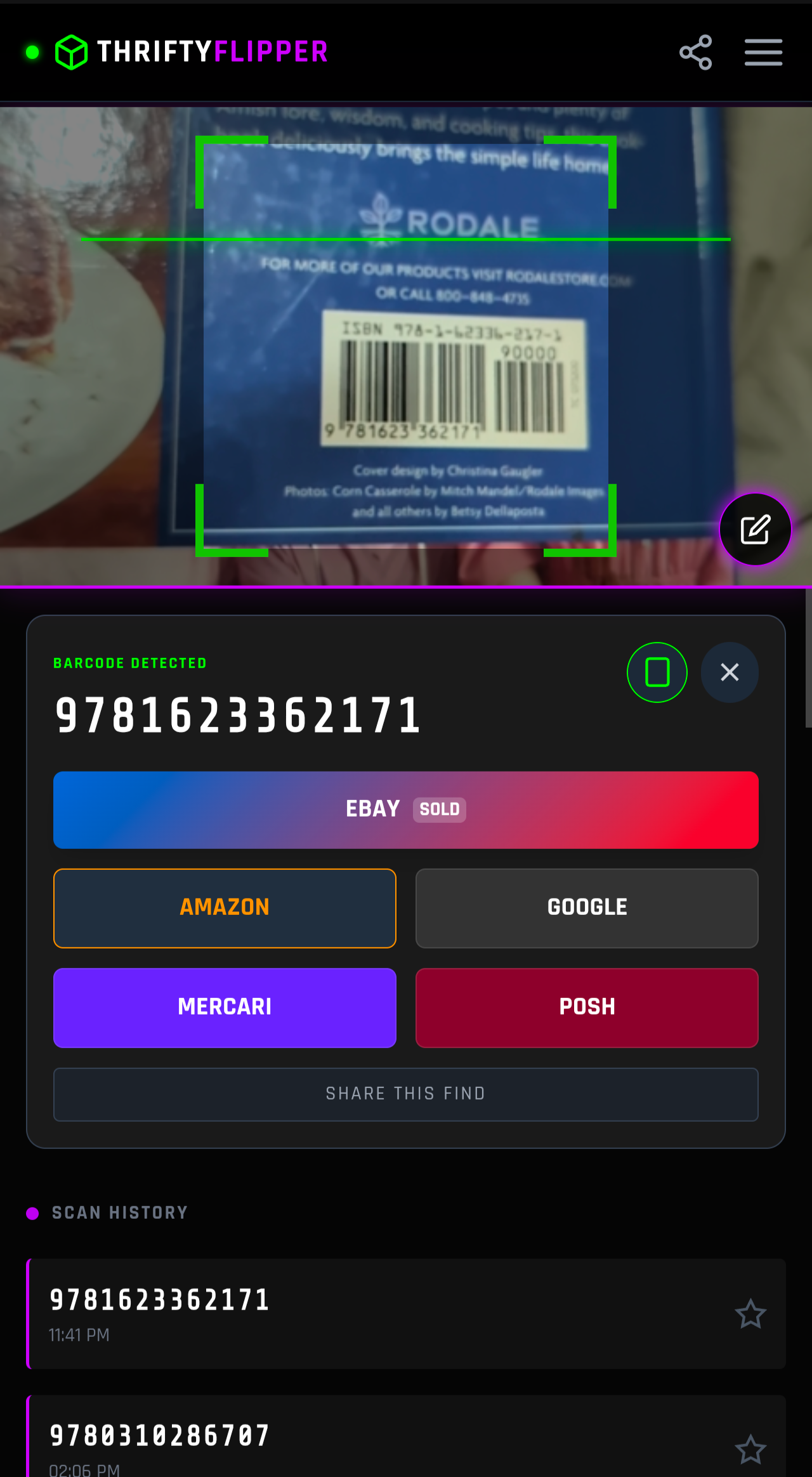
Thrifty Flipper runs in the browser. Scan a barcode and you get eBay sold listings, Amazon sales rank, and comparisons on Mercari and Poshmark on one screen, with a profit calculator that subtracts fees from your buy cost. For items that never had a barcode, it hands off to Google Lens or the keypad under the camera. No install, no account, free and ad supported. It is on Google Play as ThriftyFlipper too.
When garage sales actually happen
The calendar is not a guess. In a July 2026 count of 37,921 US yard and garage sale listings with start dates between April 1 and July 31, 39.3 percent started on a Saturday, 30.0 percent on a Friday and 15.1 percent on a Thursday. Slightly over half run exactly two days. Most open between 7am and 8am and wind down by early afternoon.
Read that split with intent, not as a popularity ranking. Saturday has the most sales, but a Saturday stop is usually that seller's second or third day open. Friday has fewer sales and better first pick, because Friday is the opening day. If you have one morning free, go Saturday at opening time. If you have two, take Friday for your best targets and Saturday for volume.
Season matters as much as day. Activity runs from April into October and peaks in June and July, so a neighborhood that hands you six sales in June hands you two in January.
Arrive at the posted start time, not before. Setup takes an hour, and a knock at 6:40am for a 7am sale does not get you in earlier. It gets you remembered as the one who pushed, which is the wrong footing for the only conversation that matters at a garage sale.
What garage sales have that a store does not
Three things, and all three work in your favor.
Nothing is priced. At a store, the shelf price is a floor you cannot argue with. In a driveway, the seller has a number in their head for maybe a third of the table and nothing for the rest. Unpriced inventory is where your offer sets the value instead of their sticker.
The seller is the decision maker. No manager, no register, no policy. The person holding the coffee can say yes to anything, and they often will, because the goal is an empty driveway rather than a maximum per item.
It is cash and it is final. There is no returns desk in a driveway, so test what you can before you pay.
When nothing carries a price
Half the table is unpriced, and that is the normal case, not a sloppy one. The seller does not know what the thing is worth and would rather you just ask.
Two rules.
Get their number first. When a seller says make me an offer, ask what they were hoping to get instead of naming a price. You get an anchor for free, and the seller who will not go first has told you they are waiting for your bid, which is worth knowing before you speak.
Scan before you name a number. The sold listings on your screen are the only objective fact in that conversation. The seller's guess and your gut are both guesses.
Bundles: how to buy a lot without losing the margin
The most profitable sentence at a garage sale is not a lowball on one item. It is what is your number if I take all of these. A single item offer gets a yes or a no, and a no ends the conversation. A pile offer makes the seller do arithmetic on a lot, and the per item figure usually comes back better. The bundle also ends their afternoon sooner.
A sequence that works.
- Scan the candidates and note what each one sells for.
- Set aside the ones that clear your bar.
- Add up what you want before you speak.
- Offer one round number for the lot. Say twenty dollars, not eighteen fifty. A round offer sounds like a decision. A precise one sounds like a spreadsheet.
- Expect a counter. It is an opening, not an insult.
- If they want more than your number, add an item to the lot instead of raising your price. Your value per item stays intact.
Bring cash and let it be visible. A folded twenty in your hand is a more real offer than an abstract counter. Do not explain the flaws to justify a lower price. They know about the scratch. Make your offer and stop talking.
Two moments in the day matter. Opening hour has the best selection and the firmest prices. The last hour is when the seller is looking at stock they will have to carry back inside, and that is where a bundle offer converts. If you are building inventory instead of hunting one item, go late.
One thing is not worth negotiating. Do not haggle over a one dollar item. Pay the dollar, keep the goodwill, and spend that credit on the box you actually want.
Scanning while the seller watches you
This is the awkward part nobody writes about. You pick up a boxed toy, your phone comes out, and the seller is now watching you photograph their stuff.
It is fine, and it takes less work than you think.
Scan in a batch, not in a pose. Walk the table first and pull the candidates into one pile, then scan the pile. Ten seconds of scanning beats two minutes of staring at your screen over the table.
Ask before you scan a box. Mind if I check a few prices almost always gets a yes, and it turns your phone from a mystery into a tool. If someone asks what you are doing, answer plainly. You are checking what the item sells for online before you buy. Chatty sellers then point you at the rest of that category, which is how you find the basement box the table crowd never saw.
Keep the screen out of their sight line. Not for secrecy, but because a seller who sees a high sold price on your screen raises their asking price. Read the number, keep it in your head, negotiate from your pile.
Do not narrate your passes. If the number is bad, put the item down and move on.
Know your stop. Five minutes of scanning per sale is plenty. If a seller seems irritated, decide faster.
What is on the tables
The composition is predictable. Kids items lead, because parents price to clear rather than to maximize: toys, children's books, board games, baby gear, outgrown clothing. Kitchen basics follow, then tools, then media, then furniture. What holds value is narrower than what is on display.
- Complete toys and games. Count the pieces. A missing die or manual erases the margin.
- Video games and consoles. Loose games are a few dollars. Complete in box with the manual is where the money is.
- Tools with a readable model plate. Buyers search brand, model and voltage, so a tool you can identify is a tool you can price in seconds. Check that the battery and charger came with it.
- Kitchen items with a brand on them. Cast iron, enamel and named glassware hide under plain dishes. Turn pieces over and read the marks.
- Books that are specific. Textbooks, technical and niche nonfiction, complete children's series.
The test underneath all of it: an item with a brand and a model number is researchable on the spot, and an item with no markings is a guess. Guesses are how you pay five dollars for something worth three. A one dollar item that nets six dollars after fees and shipping is not a flip, it is a chore. Buy the item that nets thirty. For the field method that covers boxes that will not scan, see barcode scanning apps for resellers.
Free piles
A free pile is the end state of a sale day, not a rumor. Sellers price to clear, prices soften on their own as the morning goes, and by early afternoon a box often ends up at the curb with a free sign on it. Free is the best cost basis in sourcing, and the pile gets better as the day goes on, because items the seller hoped to get a few dollars for get quietly moved over.
Scan the pile like any other. Books, board games, kids items and media show up there. Check condition hard, because a damp box of books is a disposal problem you just adopted.
How garage sales differ from estate sales
They look alike from the curb and they are two different channels.
| Garage sale | Estate sale | |
|---|---|---|
| Who runs it | The homeowner, sometimes with a friend | A professional liquidation company |
| Start day | Saturday most common, 39.3 percent of starts, Friday second at 30.0 percent | Friday most common, 37.1 percent of starts |
| Length | 51.7 percent run exactly two days, often one morning | Median three days |
| Pricing | Often nothing marked, everything negotiable | Tagged, priced against comps by the company |
| Later days | Discounts are whatever you negotiate | Roughly 25 percent off on day two, 50 percent off on day three |
| Payment | Cash only in most cases | Cards are common as well as cash |
| Inventory | Kids items, kitchenware, clothing, recent furniture | The whole household, decades of accumulation |
The scheduling consequence is the part people miss. Nearly three quarters of estate sales have already opened before Saturday morning, so a Saturday only plan meets estate sales on their third day. If your week allows one weekday, Friday is where the fresh inventory is in both channels. Estate sale pricing is researched and firm on day one, which makes them a different hunt, not a harder version of the same one.
Two neighboring channels sit either side of this one. A flea market scanner app session is a walk up to a dealer who sets the price, and a thrift store scanner app session is a fixed chain with a fixed shelf price. A driveway is the only one of the three where the number is still open when you get there.
Next steps
Keep going from here: best stores for retail arbitrage flea market scanner app thrift store scanner.