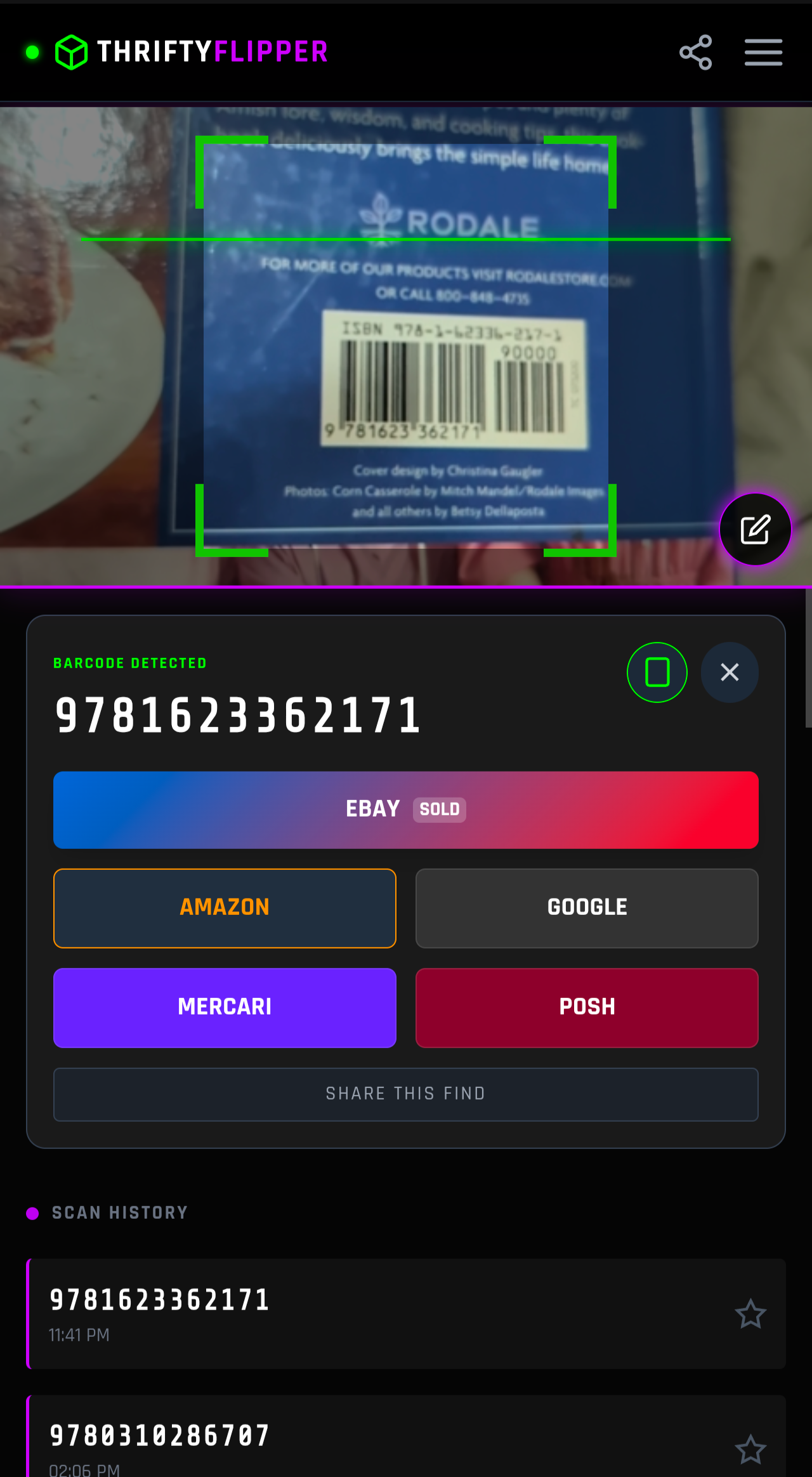
Book Scanning App: Free ISBN Scanner for Book Sales
You are standing at a library sale with a stack of hardcovers in one arm and a phone in the other. A book scanning app has one job: turn the barcode on the back cover into a buy, a pass, or a trip to the buyback pile, before you put the book down. Books are the highest volume category in reselling, so the money is not in any single scan, it is in the ratio of scans to buys. This page covers what the barcode encodes, the rank numbers that decide a purchase, the faults that kill a book, where the stock comes from, and where unsellable books end up. The scanner runs free in your phone browser, with no account and no install, and it is the same eBay arbitrage scanner that prices everything else you pick up.
The barcode on a book is the ISBN, not a UPC
Every modern book carries an ISBN-13, and the two prefixes to know are 978 and 979. Those are the GS1 prefixes reserved for books, so if the digits under the bars start with either, you are looking at an ISBN rather than a retail product code. There is no separate UPC to find, because the book trade was given its own prefix inside the global product code system, which the industry calls Bookland. The bars use the same EAN-13 format as any other retail barcode, so an ordinary scanner reads a book without a special mode, and the printed number and the barcode are one identifier rather than two records.
Books assigned before January 2007 use the older 10-digit ISBN, usually printed above the bars or on the copyright page. Both point at the same edition, so scan whichever one the camera catches, and type the 10-digit number by hand when the bars are worn. One consequence matters at listing time: for print books with a 10-digit ISBN, Amazon uses that ISBN as the ASIN. A 979 ISBN has no 10-digit equivalent by design, so Amazon's page for that edition carries a ten-character alphanumeric ASIN. When an app returns nothing for a 979 barcode, the app is the problem, not the book.
The small second barcode is a price, not a product code
To the right of the main barcode there is often a much smaller 5-digit code. That is an EAN-5 supplement, and it encodes the publisher's suggested retail price. The first digit is the currency, where 5 means US dollars and 6 means Canadian dollars, and the last four digits are the price, so 51999 is $19.99. 59999 means $100 or more and 90000 means no price was encoded at all. Cash registers read that code. Marketplaces ignore it. Scan the 13-digit code beside it.
The scan-to-buy ratio is the whole business
At a decent library sale you will scan hundreds of books to buy a few dozen. A book scout program's published numbers put it plainly: if you check every book on a table you buy about one in a hundred, an experienced scout buys about one in ten of the non-fiction titles they call in, and full-time scouts find more than 300 books a week. The reason is arithmetic. A table of 300 books costs 15 to 20 minutes of scanning before you have decided anything. Set three trigger rules before you walk in, a minimum price, a minimum profit after fees and a rank ceiling, and let the bad books reject themselves.
Sales rank is the sell-through proxy
Amazon's sales rank is the only free signal on the page for how fast a book moves. Amazon's own documentation describes it as a ranking based on customer activity relative to other books, updated at least once a day with changes that can take up to two days to appear, weighted toward recent activity and with canceled orders excluded. Rank is relative, so your book does not have to sell less for its number to get worse, other books only have to sell more. Amazon also states that rank is not an accurate way to track a book's activity, so treat it as a speed filter, not a sales count.
| Overall rank | What it usually means |
|---|---|
| Under 1,000 | Strong seller, 120+ copies a day |
| Under 10,000 | Selling well, 20+ a day |
| Under 100,000 | Steady, about a copy a day |
| 100,000 to 500,000 | Occasional, a few a month |
| Past 500,000 | Often zero sales in a month |
| Around 3,000,000 | Effectively never sells |
Where the unsellable line sits is a convention rather than an Amazon rule. Many sellers draw it at 1,000,000, and past 500,000 is treated as slow. Measured seller data argues against a hard cut: a bookseller tracking his own stock found about 95 percent of his books ranked under 100,000 sold within roughly a year, 33 percent of those in the 2,000,000 to 3,000,000 range sold too, and everything past 1,000,000 produced 42 percent of his earnings. Rank does not decide what a book is worth, it decides when your money comes back. Two filters beat one number: skip a 1,000,000+ book when a newer edition exists, and skip a mainstream subject with five or fewer competing used offers, because nobody has tested that price. A published trigger setup auto-accepts under 500,000 and auto-rejects above 2,000,000.
Condition kills more book deals than price does
A green scan is a promise the book has to keep. Check the copy in your hand, because these are the faults that turn a listed price into a return.
| Fault | What it costs you |
|---|---|
| Ex-library: stamps on page edges, a plastic sleeve, spine stickers, a card pocket | Collectible grades exclude former library books, so grade no higher than Acceptable and note EX-LIBRARY. |
| Water damage: ripples, warping, tide lines, a musty smell | Minor water damage that does not affect readability is allowed at Acceptable, but buyback terms reject moisture, staining and mould. |
| Highlighting and notes | Limited notes at Good and considerable notes at Acceptable, as long as the text is not obscured. Buyback rejects marking. |
| Missing dust jacket | Allowed up to Very Good, and at Acceptable the dust cover may be missing. Like New requires it intact. |
| Ex-rental and store stickers | A sticker over the barcode stops the scan, and residue costs the Like New grade. |
| Remainder marks and book club editions | A remainder mark is allowed even at Like New but must be noted, and neither can be listed as New or Collectible. |
| Advance reading copies and uncorrected proofs | Unacceptable for in-print titles, so a proof is a pass unless it is out of print. |
Three faults decide a book: one stops the scan, one stops the reading, one stops it being collectible. Price survives the rest.
Where book inventory actually comes from
Library sales. The cheapest reliable source in most markets, and the most structured. Friends of the Library groups typically price mass-market paperbacks at $0.25 to $1, trade paperbacks at $1 to $2, hardcovers at $1 to $3 and textbooks or specialty titles at $2 to $10, then drop to a flat bag day at $3 to $10 a bag. One library group sells a standard brown paper grocery bag of books for $10. Preview night costs full price plus a small admission or membership fee and is the only session with real selection, because the sale then runs half price and finishes with a bag day. Many Friends groups also screen donations and pull anything they price at $8 or more for their own online store, so assume the top of the pile is gone.
Estate sales. Books are priced flat by format at the start and consolidated into box lots at a flat price per box by the last day. Find whoever is running the sale in the closing hour, ask for one price on everything left in the book room, and take all of it rather than cherry picking.
Church sales, rummage sales and garage sales. The same model as a library sale with less volume, priced to clear, and usually the weakest competition on the calendar.
Thrift stores. Regular stores price books per item, usually $1 to $3. Pay-by-the-pound outlets, including Goodwill Outlets, price books per item (often $1 each or ten for $1), by spine inch ($0.49 to $1.49 depending on region) or by weight ($1 to $2.49 a pound). Weight is where a bulk buyer wins, with one condition attached: you pay for everything in that cart, including the books you could not scan fast enough to leave behind.
The exit for books that will not sell retail
Every pile ends with books too slow to list one at a time. The exit is wholesale buyback: a vendor quotes a price per ISBN, you ship on their label, and they pay on receipt. It pays a fraction of retail, and it exists so slow books return their cost.
BookScouter is the comparison layer: one ISBN search returns offers from more than 30 buyback vendors, shipping is free, and payment often lands the same day the books are received. BooksRun buys back by ISBN, issues a prepaid USPS label once an order totals more than $8, and pays by check or PayPal. TextbookRush shows the fine print: prepaid FedEx labels, books shipped within five business days, two to three days of check-in, quantity limits per ISBN, and rejected books are not returned. BookTrolls is the flat-rate version, paying $3.75 for every book it tells you to buy and reimbursing Media Mail postage.
Scan the buyback quote in the same pass as the retail price: a $14 offer on a $2 sticker is a buy whatever its rank, and no offer with a bad rank is a donation.
Media fees are higher, and they set your floor price
Books sit in media categories, and media fees run above the standard rate on both major marketplaces. This is the number new scouts leave out.
| Marketplace | Category | Fee on a sale |
|---|---|---|
| eBay | Most categories | 13.6% up to $7,500 per item, then 2.35% |
| eBay | Books & Magazines, Movies & TV, Music | 15.3% up to $7,500 per item, then 2.35% |
| eBay | Per-order fee, both tiers | $0.30 on orders of $10.00 or less, $0.40 above $10.00 |
| Amazon | Books, DVD, Music, Software, Video | 15% referral with no minimum shown, plus a $1.80 closing fee per item |
Three things follow. eBay charges its percentage on the total amount of the sale, and that total includes the shipping the buyer paid, so free shipping is not free. The Amazon closing fee is charged per item whether the book sells for $40 or $4, which is why a $5.99 paperback pays $0.90 in referral fee plus $1.80 in closing fee, leaving $3.29 before shipping or fulfilment. And the 13.6% to 15.3% spread repeats on every media sale, 34 cents on the same $20 book before the per-order fee. Run the net number before you buy, with the arbitrage calculator, not after you get home.
The decision, per book
| What you see | What to do |
|---|---|
| 13 digits starting 978 or 979 | Scan it, that is the ISBN |
| 10 digits printed above the bars | Type it by hand when the bars will not read |
| A small 5-digit barcode to the right | Ignore it and scan the main code |
| Rank inside your ceiling, live used price | Check the condition, then buy |
| Rank past your ceiling | Pass, unless the buyback quote clears your minimum |
| Ex-library markings, water damage or a proof | Put it back |
| A buyback quote several times the sticker | Buy it for the buyback pile |
A book scanning app is the right tool for that loop, and the same camera that reads an ISBN reads the retail world's UPC codes. The parent guide to the site's scan-and-check workflow is the barcode price checker, and the same loop runs in the video game value checker and the clothing reseller app for books' sibling categories. When you are home deciding where a book actually sells, the homepage is the fastest route to live sold comps.
Next steps
Keep going from here: barcode price checker arbitrage calculator video game value checker.