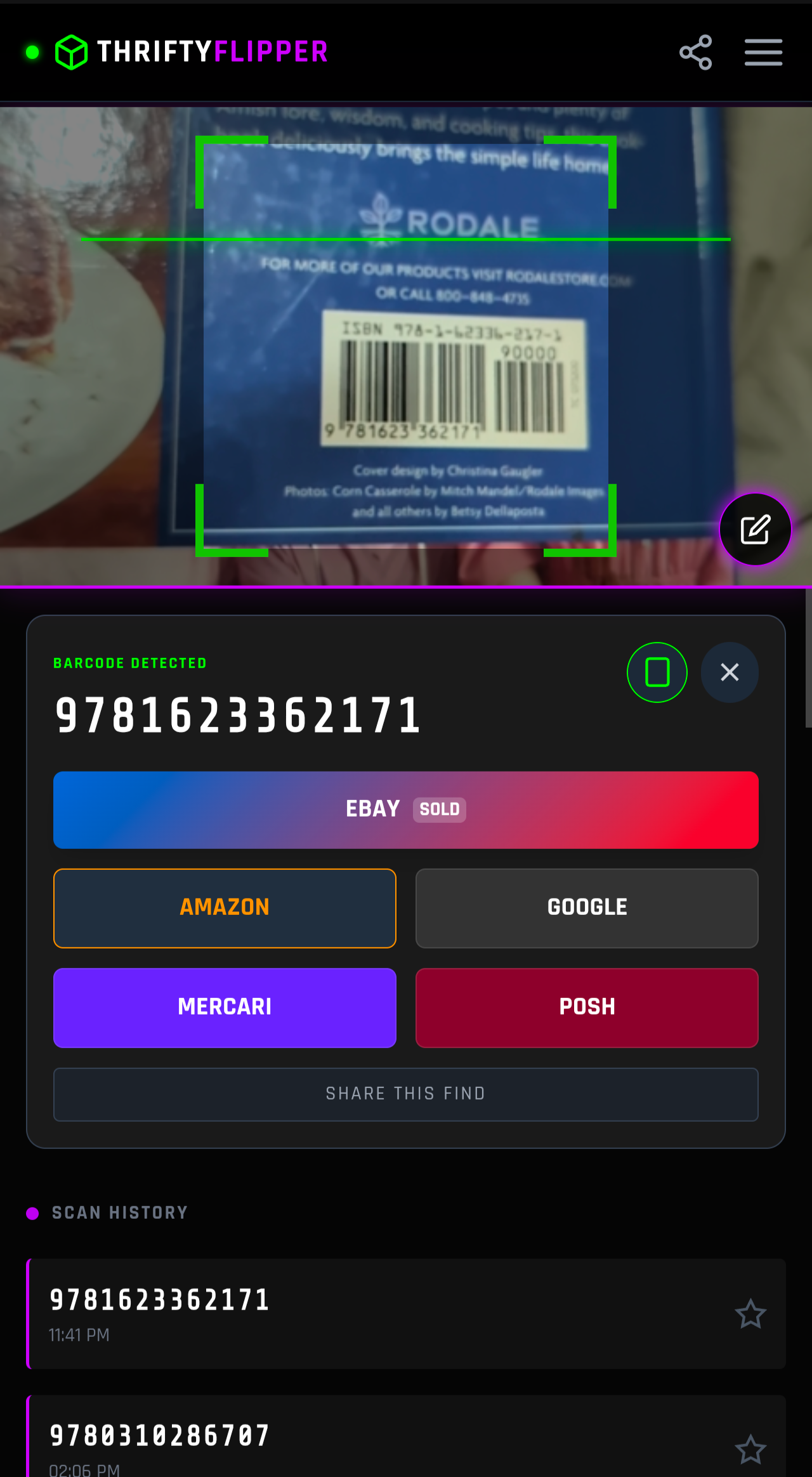
Barcode Scanning Apps for Resellers
A barcode scanning app for resellers has one job: turn the digits on a package into a buy or pass decision in a few seconds, while you stand in the aisle. That is harder than it sounds, because a scan fails in more ways than it works. The label is scraped. The shrink wrap throws glare back at the camera. The lookup returns last year's model. The store has no signal in the back corner. This page is about choosing the app and about getting a usable answer anyway.
What a scanning app has to do before it earns a spot on your phone
Five tests. Most apps fail at least two of them.
- Read a UPC-A code with the camera alone. No paired hardware, no laser gun in your bag. A 12-digit UPC-A on a box is the common case, and the camera on a phone you already carry handles it.
- Return sold comps, not asking prices. This is the difference between a tool and a toy. The top of an eBay search shows what sellers want. The sold filter shows what buyers paid. A listing showing $49.99 active and $22 sold is a $22 item, and someone who only reads the first number buys it anyway.
- Do the fee math before the purchase. An item that makes $8 at a 13.6 percent marketplace fee before shipping is not an $8 item on the shelf. If the app hands you a profit number without subtracting marketplace fees, it is showing you revenue and calling it profit.
- Work without an account or a download. Every install and every login is friction in a store. A browser based scanner opens from a home screen shortcut, scans immediately, and has nothing to update at 7am before the garage sales start.
- Handle the items with no barcode at all. Loose clothing, vintage goods, anything unboxed. If the app has no photo path, it covers maybe half of what a thrift store actually contains.
What the scanning apps cost in 2026
Prices checked in September 2026. Check them again before you subscribe, because this market repriced twice this year.
| App | Cost | What a scan returns | Install required |
|---|---|---|---|
| Thrifty Flipper | Free, ad supported | eBay sold listings, Amazon sales rank and price, Mercari and Poshmark comparisons, Google Lens for items with no barcode, plus a profit calculator with eBay fees | No. Runs in the browser on iOS Safari or Android Chrome |
| ScoutIQ | $44 per month, $36 per month billed annually at $432. Live-only plan is $14 monthly or $10 annually. 14-day trial | Amazon data for books and general items, with a downloadable database for scanning without signal | Yes, iOS or Android, and an account |
| Profit Bandit | $9.99 per month | Amazon pricing, restrictions and profit calculation | Yes, iOS or Android |
| Keepa | Free tier with limits, Pro at EUR 29 per month or EUR 290 a year | Amazon price and sales rank history. A tracking tool more than a scanner | Browser extension or app, account required |
The free option is a browser. The paid options are apps with databases, and a downloadable Amazon database is genuinely worth paying for if your entire sourcing plan is used books. If it is not, you are paying $44 a month to answer a question that a camera and a sold listings filter answer for nothing.
What happens between the beep and the price
The scanner does not read a product. It reads a 12-digit string. Three things happen after that, and only the third one decides whether you make money.
- Code to catalog. The digits are matched against a product database for a title, brand and model. Mismatches are born here. Store brands, multipacks and last year's model share packaging with the current one.
- Catalog to listing. On Amazon the match continues from catalog entry to ASIN, which is what your offer attaches to. On eBay there is no ASIN, so the UPC becomes a search and you read the titles yourself.
- Listing to verdict. Sold listings in roughly the last 90 days are the only number that means anything. Check how many sold against how many are still listed. Thirty sold against three hundred listed is a crowded item.
Read the returned title against the package in your hand before you trust any price on the screen. That one check removes the most expensive silent error in sourcing.
When a scan fails
| Symptom | Usual cause | Fix in the field |
|---|---|---|
| Camera will not lock on | Glare off shrink wrap or a plastic clamshell | Tilt the item 30 to 45 degrees so the reflection slides off the code, or scan a code on another panel of the box |
| Beeps, wrong product appears | A store price sticker covering the manufacturer code | Peel one corner back and scan the original code underneath |
| Bars visible but nothing reads | Scratched, water damaged, or taped over label | Type the digits instead. Full workflow on manual barcode entry when a label will not scan |
| Digits will not resolve at all | Non-US packaging with a 13-digit EAN-13 code, or a 14-digit ITF-14 case code on a multipack | Try it as a search string. Case codes usually belong to the whole case, not the unit you are holding |
| Scan works, lookup never returns | No signal in that part of the store | Decode locally, resolve later. See the next section |
| Match shows a different size or color | The catalog entry groups variants | Check the variant against the physical item. Variant mixups are the most expensive silent error in scanning |
Scanning in stores with no signal
The camera decode happens on your phone. Resolving the price does not. Two practical consequences:
- In a store with dead zones, scan and hold. The valid codes queue, and ten of them resolve in under a minute once you walk into coverage near the front doors or in the parking lot.
- A scanner that shows full prices with no signal is reading a cached database, and cached prices are wrong in exactly the place you need them. Clearance is where the live price and the database price diverge fastest.
Do you need a Bluetooth scanner
No, not to start. A phone camera reading UPC-A codes at a handful of inches is accurate enough for sourcing, and it is the hardware you already own. A dedicated Bluetooth scanner earns its place in two situations: you spend entire days in outlet aisles pulling dozens of units of the same item, or you scan one handed while carrying something. It buys wrist comfort and speed, not accuracy, and it adds a device to charge and lose. Under about fifty scans on a trip, stay on the camera.
Next steps
Keep going from here: manual barcode entry app upc vs ean for resellers arbitrage calculator.